PSB Dearness Allowance Rises to 31.33% for November 2026 Quarter
Public sector bank employees will receive a 3.50 percentage point Dearness Allowance hike, taking the rate to 31.33% of basic pay for the November 2026 to January 2027 quarter. The revision applies across IBA member banks under the 12th Bipartite Settlement formula based on recent CPI-IW figures.
Public Sector Banking DA Increase for November 2026 to January 2027
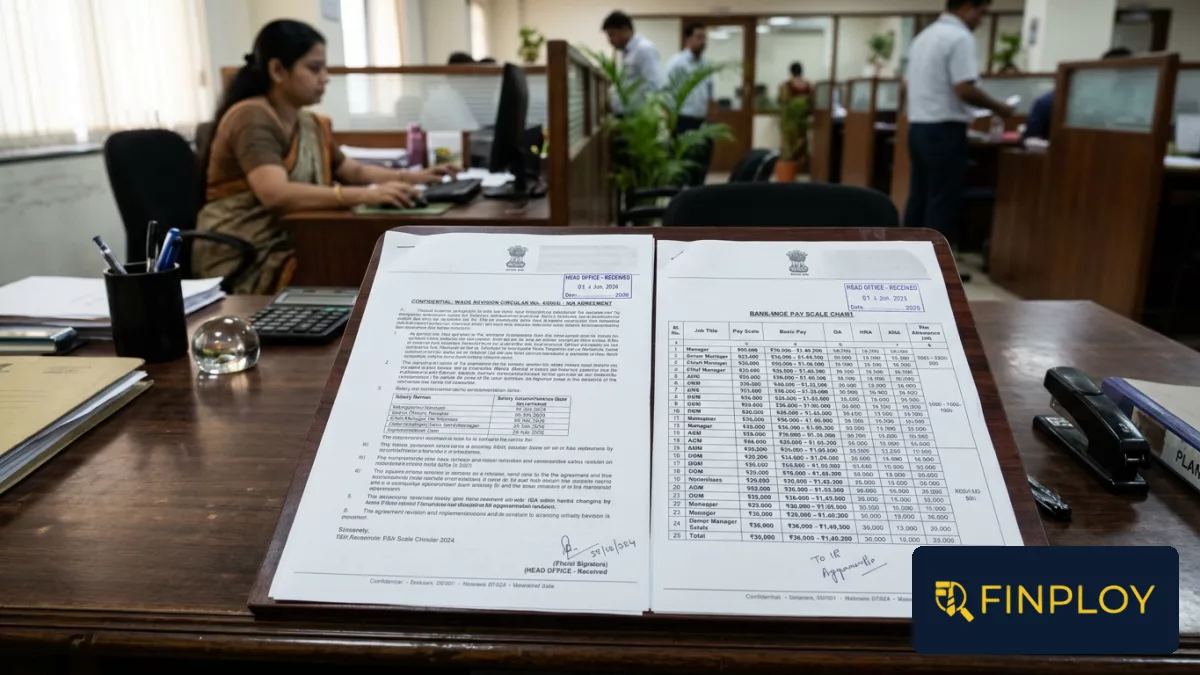
Public sector bank employees across India will receive an upgraded Dearness Allowance (DA) payout starting from 1 November 2026. According to official communications issued by the All India Bank Employees' Association (AIBEA), Circular Letter 19.45 confirms that the revised DA rate will increase by 3.50 percentage points. This adjustment elevates the total quarterly DA from 27.83% to 31.33% of basic pay. The revised allowance structure remains effective for the three-month period extending from 1 November 2026 through 31 January 2027.
Dearness Allowance across Indian public sector banking institutions undergoes a structured quarterly revision cycle occurring in February, May, August, and November of every year. These periodic shifts are designed to offset broader cost-of-living increases and cushion institutional staff against ongoing fluctuations in consumer prices. The latest revision represents a notable upward movement in variable monthly compensation for all covered banking cadres across the country.
Understanding the 12th Bipartite Settlement Formula and CPI-IW Calculation
The revised quarterly DA percentage is calculated directly under the established 12th Bipartite Settlement (12th BPS) framework agreed between bank management representatives and trade unions under the Indian Banks' Association (IBA). According to technical reporting by BankersClub, the valuation formula applies the Consumer Price Index for Industrial Workers (CPI-IW) with 2016 as the baseline year, using the explicit mathematical relationship: DA % = Quarterly Average CPI-IW (2016=100) − 123.03.
The calculation relies on official index data collated and released by the Labour Bureau for the relevant evaluation quarter. The monthly CPI-IW figures published during this evaluation period were recorded at 153.20 points for July 2026, 154.40 points for August 2026, and 155.50 points for September 2026. When averaged across the three months, these figures generated a quarterly average CPI-IW of 154.36 points. This average reflects a substantial climb from the previous quarter's index average of 150.86 points.
Prior to the final publication of the September 2026 index by the Labour Bureau, early industry projections published by financial commentators had estimated an upcoming DA rate of 31.37%. That preliminary estimate was derived from an assumed quarterly average index of 154.40 points. However, as clarified in final union documentation from AIBEA, the confirmed Labour Bureau index average of 154.36 points established the official binding DA rate precisely at 31.33% of basic pay.
Salary Components Affected and Excluded Under the New Allowance Structure
The application of the 31.33% DA rate alters specific segments of a bank employee's monthly pay slip. As outlined in salary analysis published by Arthzo, the 12th BPS DA rate applies strictly to defined compensation heads. These eligible components comprise Basic Pay (which includes any accumulated stagnation increments), Special Allowance, Professional Qualification Pay (PQP) or Graduation Pay, Special Pay, Transport Allowance for clerical and sub-staff cadres, Learning Allowance for officer cadres, and Officiating Pay where applicable.
It is equally important for banking staff to recognize which components remain unaffected by this quarterly revision. House Rent Allowance (HRA) does not increase when DA rates rise, because HRA calculations under bank pay rules remain strictly tied to Basic Pay alone, independent of cost-of-living adjustments.
From an income tax perspective, Dearness Allowance disbursements are treated as fully taxable income. As detailed by Arthzo, bank DA is subject to applicable income tax under both the old tax regime and the new tax regime. Nevertheless, because statutory employee benefit contributions—specifically allocations toward the National Pension System (NPS) and Provident Fund (PF)—are calculated as a percentage of Basic Pay plus DA, the 3.50 percentage point hike results in a minor mandatory increase in monthly retirement fund contributions for covered bank personnel.
Cadre-Wise Impact: Take-Home Net Monthly Pay Revisions
The 3.50 percentage point expansion marks the single largest quarterly DA jump recorded under the 12th Bipartite Settlement framework to date. The absolute monetary increase in monthly pay varies across employee cadres, pay scales, and length of service.
At the entry level, a clerical employee at Stage 1 receives a net monthly salary increase of approximately ₹1,107 per month. This payout scales upward through higher clerical stages and senior officer ranks. At the highest administrative pay scale, a Scale VII officer positioned at top stagnation stages sees a net monthly salary increase reaching up to ₹8,730 per month.
| Employee Cadre & Pay Scale Stage | Estimated Monthly Take-Home Increase | Applicable Salary Components |
|---|---|---|
| Clerical Cadre (Entry-Level Stage 1) | Approx. ₹1,107 per month | Basic Pay, Transport Allowance, Special Pay |
| Officer Cadre (Scale VII Top Stagnation) | Up to ₹8,730 per month | Basic Pay, Learning Allowance, Special Allowance, Stagnation Increments |
Institutional Scope and Coverage Discrepancies Across BFSI Sub-Sectors
The operational coverage of the AIBEA circular is defined strictly by organizational structure and IBA membership. As confirmed by joint documentation from AIBEA and the IBA, this DA revision applies across clerical staff, sub-staff, and officer cadres up to Scale VII employed at Indian Banks' Association member banks. This mandate encompasses all Public Sector Banks (PSBs) nationwide as well as the State Bank of India (SBI). Additionally, existing bank pensioners receive a corresponding upward adjustment in their quarterly Dearness Relief (DR) payouts for the November 2026 to January 2027 cycle.
Conversely, professionals working across other segments of the financial sector must note the institutional limits of bipartite settlements. Analysis published by Arthzo emphasizes that non-IBA member private sector banks, Non-Banking Financial Companies (NBFCs), and insurance firms are not governed by IBA settlements. These non-IBA institutions operate under distinct pay models, structured annual appraisal systems, or individual performance-linked incentive frameworks rather than mandatory quarterly DA adjustments.
BFSI Hiring Trends and Location-Wise Job Distribution
For job seekers and finance professionals evaluating public versus private career paths, institutional pay mechanisms offer distinct financial dynamics. Regular quarterly inflation adjustments in public sector banks preserve purchasing power against rising consumer prices, providing wage stability relative to fixed-pay structures common in non-IBA financial entities.
According to Finploy platform data as of 2 November 2026, there are currently 41,106 open jobs listed across the Indian banking, financial services, and insurance sector. The geographical distribution of these opportunities indicates strong recruitment demand in primary commercial and tech centers:
- Mumbai: 11,219 open roles
- Pune: 1,080 open roles
- Chennai: 1,000 open roles
- Bengaluru: 963 open roles
- Hyderabad: 789 open roles
- Bangalore: 570 open roles
- Thane: 503 open roles
- Kolkata: 425 open roles
This employment distribution illustrates that while public sector banking opportunities feature standardized pay structures across nationwide branch networks, broader financial sector hiring remains heavily concentrated in major metro areas such as Mumbai, Pune, Chennai, and Bengaluru. Professionals exploring roles across public sector banks, private institutions, and NBFCs can weigh quarterly inflation protection against regional employment trends in these primary hiring hubs.
Retirement Benefits, Tax Considerations, and Workplace Advocacy
While the immediate consequence of the DA hike is an enhanced monthly salary payout, the structural financial impact extends into long-term retirement planning. Because statutory deductions for Provident Fund and National Pension System contributions are linked to the combined sum of Basic Pay and DA, a higher DA rate automatically expands long-term retirement accumulation for eligible staff.
From a short-term liquidity perspective, employees must factor in tax obligations. Since DA remains fully taxable under both old and new income tax regimes, net take-home pay will reflect applicable income tax deductions at individual slab rates.
Beyond individual compensation updates, union leadership continues to address broader workforce requirements. Documents from AIBEA and the United Forum of Bank Unions (UFBU) note that while index-linked DA revisions protect real wages against inflation, union representatives remain actively engaged in advocating for broader structural workplace changes, including the ongoing demand for a standardized 5-day banking workweek across public sector banks.
Frequently asked questions
What is the revised Dearness Allowance rate for public sector bank employees from November 2026?
The revised Dearness Allowance rate is 31.33% of basic pay for the November 2026 to January 2027 quarter, representing a 3.50 percentage point increase from the previous rate of 27.83%.
Which salary components increase with the 12th Bipartite Settlement DA hike?
The DA hike applies to Basic Pay, Special Allowance, Professional Qualification Pay, Special Pay, Transport Allowance, Learning Allowance, and Officiating Pay. It does not increase House Rent Allowance, which remains tied strictly to Basic Pay.
Are private bank and NBFC employees eligible for this DA revision?
No, non-IBA member private banks, NBFCs, and insurance companies are not automatically covered by IBA Bipartite Settlements, as they follow separate wage structures and annual appraisal cycles.

Archana Jain
Archana Jain is the Founder and CEO of Finploy Technologies, a recruitment platform built exclusively for banking, financial services and insurance (BFSI) hiring in India and Singapore. She has led Finploy since 2020 and has been Chief Operating Officer of Deeesha Finance & Finploy Finance Employment since 2016. Her work focuses on bank and NBFC hiring: leadership roles, home loan and LAP sales, CASA and retail banking, credit and underwriting, collections and recovery, and relationship management, across 1,500+ locations in India. She reviews Finploy Insights articles before they are published.