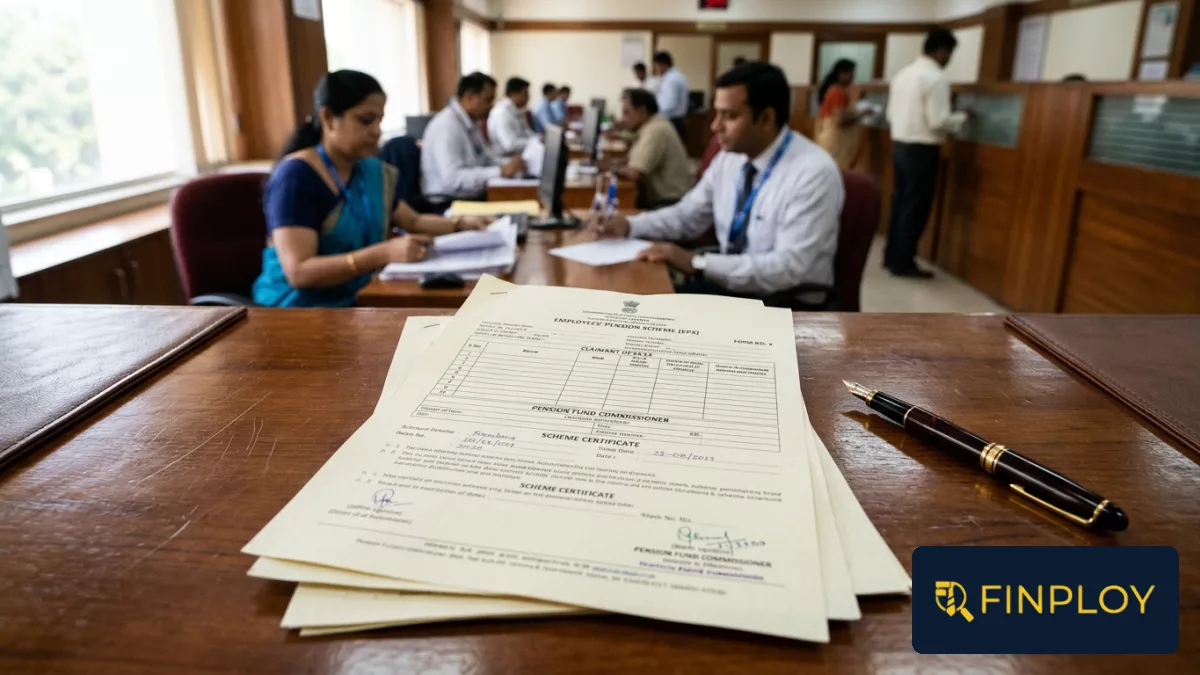
EPFO Extends September ECR Deadline to October 31 Following Wage Ceiling Hike
The Employees' Provident Fund Organisation has extended the September 2026 ECR filing and statutory contribution deadline to October 31, 2026, following the mid-month increase in the monthly wage ceiling to ₹25,000. This guide details the split-payroll rules, salary impacts, employer cost structures, and current BFSI hiring trends for compliance specialists.

In a significant compliance relief for employers across the financial services ecosystem, the Employees' Provident Fund Organisation (EPFO) extended the deadline for filing the Electronic Challan-cum-Return (ECR) and depositing statutory provident fund contributions for the September 2026 wage month. As reported by The Economic Times, the submission cut-off date has been pushed from 15 October 2026 to 31 October 2026. This administrative extension provides banks, non-banking financial companies (NBFCs), and insurance firms essential breathing room to recalibrate automated payroll software, compute split-month contributions, and ensure accurate statutory deductions following a major upward revision in statutory wage limits.
The timeline modification stems directly from the central government's decision to hike the statutory monthly EPF wage ceiling from ₹15,000 to ₹25,000. According to Mint, the revised ceiling was formally notified vide S.O. 5109(E) on 17 September 2026 and took effect immediately. Because the notification landed in the middle of the September wage cycle, payroll departments across corporate India faced significant operational hurdles in calculating mid-month adjustments. The deadline relief ensures that financial institutions can complete these technical updates without facing regulatory penalties or legal interest charges.
Regulatory Mechanics and Official Circular Directives
To formalize the deadline extension, the retirement fund body issued an official notification. As detailed by CorpLawUpdates.in, EPFO released Circular No. Compliance/AnnAcPlan/2022-23/RationalizationofECR-Part(1)/e-704368 on 13 October 2026. In issuing this order, the authority invoked legal powers granted under the second proviso to Paragraph 28(3) of the Employees' Provident Funds Scheme, 1952. The circular clarifies that filings completed on or before 31 October 2026 will be treated as submitted within the statutory timeframe, shielding employers from penal damages under Section 14B and interest liabilities under Section 7Q of the EPF Act.
This relief followed formal representations from prominent industry organizations. According to Nasscom Community, industry bodies including Nasscom and various employer associations submitted detailed representations to the EPFO highlighting complex technical, operational, and administrative obstacles in recalculating split-payroll liabilities for September. Enterprise software architectures had to be updated mid-cycle to manage two separate deduction frameworks within a single calendar month.
It is important for human resources and finance leaders to recognize the specific scope of this directive. As noted by CorpLawUpdates.in, the deadline extension is strictly a one-time measure applicable only to the September 2026 wage month. The filing deadline for the October 2026 wage month remains firm at 15 November 2026, giving establishment administrators a brief window to permanently stabilize their automated systems.
Split-Payroll Computation Rules for September 2026
The primary technical challenge triggering the ECR extension involves the execution of split-payroll rules. As reported by The Economic Times, September 2026 must be treated as a dual-rate computation month due to the mid-month implementation date of 17 September 2026:
- First Half (1 September to 16 September 2026): Statutory provident fund contributions for this 16-day period are calculated based on the legacy monthly wage ceiling of ₹15,000.
- Second Half (17 September to 30 September 2026): Contributions for the remaining 14 days are calculated under the newly introduced monthly wage ceiling of ₹25,000.
For institutions that cap employee provident fund deductions at the statutory limit, this change alters monthly cash flows. According to Mint, the maximum monthly employee contribution for capped establishments increases from ₹1,800 (12% of ₹15,000) to ₹3,000 per month (12% of ₹25,000). During September, the final deduction reflects a proportional blend of these two rates based on the active days under each regime.
Impact on Salaried BFSI Professionals, EPS, and EDLI
The upward shift in the EPF wage ceiling brings broad structural changes to employee remuneration and long-term financial security across the banking, financial services, and insurance sector. According to The Economic Times, employees earning up to ₹25,000 per month in banks, NBFCs, and insurance firms who were previously excluded from mandatory coverage—or capped at the ₹15,000 basic threshold—will experience an increase in monthly statutory PF deductions. While this adjustment results in a slight decrease in immediate net take-home pay, it expands employee retirement accumulation over time.
The ceiling modification also affects allied statutory schemes, including the Employees' Pension Scheme (EPS) and the Employees' Deposit Linked Insurance (EDLI) scheme:
1. Pension Scheme Rules and Clarifications
To avoid administrative ambiguity regarding pension allocations, the government issued specific guidelines. As reported by The Economic Times, a Labour Ministry clarification issued on 15 October 2026 specifies that the central government's contribution to the Employees' Pension Scheme (EPS) remains capped at 1.16% of wages up to ₹15,000 per month, establishing a maximum contribution limit of ₹174 per month. Even though the EPF wage threshold has expanded to ₹25,000, the central government's contribution ceiling under EPS remains unchanged at the ₹15,000 reference rate.
2. Group Life Insurance Expansion
According to The Economic Times, the higher wage ceiling automatically broadens the underlying benefit framework for EDLI. By raising the maximum covered salary threshold, the insurance benefit entitlement for surviving families of covered workers increases, while slightly expanding monthly premium contribution liabilities for financial sector employers.
| Parameter | Legacy Ceiling Framework | Revised Ceiling Framework |
|---|---|---|
| Statutory Monthly Wage Ceiling | ₹15,000 per month | ₹25,000 per month |
| Max Monthly Employee PF Deduction (12%) | ₹1,800 per month | ₹3,000 per month |
| Govt EPS Contribution Cap (1.16%) | ₹174 per month (up to ₹15,000) | ₹174 per month (capped at ₹15,000) |
| Filing Deadline for Sept 2026 ECR | 15 October 2026 | 31 October 2026 (Extended) |
| Filing Deadline for Oct 2026 ECR | 15 November 2026 | 15 November 2026 (Unchanged) |
Employer Cost Structures and Software recalibration
From an enterprise finance perspective, the revised rules demand adjustments to manpower budget projections. As reported by The Economic Times, financial entities that offer statutory matching contributions up to the official ceiling face higher monthly employer contributions per eligible staff member. HR and finance leadership must absorb these escalated costs into their Q3 and Q4 budget cycles.
Simultaneously, HR operations and payroll managers across financial institutions experienced operational bottlenecks while updating enterprise resource planning (ERP) platforms. As noted by Mint, payroll management systems (PMS) required immediate recalibration to execute split calculations for September wage month processing without triggering errors during file upload on the EPFO portal.
BFSI Compliance Job Market and Hiring Data
The implementation of Social Security Code provisions and statutory realignments has altered recruitment patterns across the financial sector. According to Finploy Industry Insight and The Economic Times, the mid-year rollout of these revised regulations has driven heightened hiring demand for specialized talent across private sector banks, NBFCs, and insurance firms. Institutions are actively recruiting Payroll Managers, Compensation & Benefits (C&B) Specialists, PF Auditors, and Labour Compliance Officers to manage statutory compliance without operational risk.
To understand where these operational and compliance opportunities are concentrated, job seekers can evaluate regional demand patterns. Data from Finploy's job market listings shows a substantial volume of open roles across major Indian financial centers:
- Total Open BFSI Jobs Listed on Finploy: 43,262 positions nationwide.
- Mumbai: 11,232 open positions, serving as the primary hub for corporate headquarters, central compliance teams, and enterprise payroll divisions.
- Bengaluru: 1,163 open positions, driven by fintech, banking tech operations, and regional hub management.
- Pune: 1,116 open positions, reflecting growing shared services centers for global and domestic financial firms.
- Chennai: 1,031 open positions, supported by retail banking administrative operations and back-office hubs.
- Hyderabad: 834 open positions, focused on financial operations and technology integrations.
- Bangalore (Regional Sub-listings): 570 open positions across specialized financial management functions.
- Thane: 528 open positions, catering to suburban operational centers and NBFC administrative offices.
- Kolkata: 456 open positions, addressing eastern regional operations and insurance agency management.
For mid-level payroll and legal compliance professionals, mastery of split-payroll systems, EPF Act nuances, and automated ECR reconciliation has become a practical asset, accelerating career mobility within private banking and non-banking financial frameworks.
Action Plan for BFSI Payroll and Compliance Teams
To maximize the benefit of the extended October 31 deadline and avoid downstream complications, enterprise payroll teams should complete a structured checklist:
- Reconcile Dual Salary Slices: Confirm that employee basic salary records accurately segregate the 1–16 September window (₹15,000 cap) from the 17–30 September window (₹25,000 cap) before finalizing ECR text files.
- Validate EPS Contribution Limits: Ensure that the employer portion allocated to EPS strictly respects the ₹174 monthly limit as clarified by the Labour Ministry, directing any excess employer contribution into the EPF account balance.
- Audit Master Employee Records: Verify newly eligible employees earning between ₹15,001 and ₹25,000 to ensure accurate Universal Account Number (UAN) generation and linking prior to monthly submission.
- Prepare for November Timelines: Prepare payroll management systems well in advance for the October wage month submission, which remains tied to the standard 15 November 2026 deadline.
By leveraging this extended timeline effectively, financial institutions can maintain compliance, protect employee retirement benefits, and ensure smooth operational execution during this regulatory transition.

Archana Jain
Archana Jain is the Founder and CEO of Finploy Technologies, a recruitment platform built exclusively for banking, financial services and insurance (BFSI) hiring in India and Singapore. She has led Finploy since 2020 and has been Chief Operating Officer of Deeesha Finance & Finploy Finance Employment since 2016. Her work focuses on bank and NBFC hiring: leadership roles, home loan and LAP sales, CASA and retail banking, credit and underwriting, collections and recovery, and relationship management, across 1,500+ locations in India. She reviews Finploy Insights articles before they are published.