EPF Withdrawal Rules: Complete Guide to Forms, Tax Rules, and Pension Claims
The Employees' Provident Fund Scheme, 2026 restructured PF withdrawal rules in June 2026, including a 25% minimum balance retention rule. Separately, EPFO had already raised the auto-settlement cap for advance claims to ₹5 lakh in June 2025. This guide covers both changes, the withdrawal forms (19, 31, 10C) and the tax rules that apply.

1. Updated Structural Framework of EPF Withdrawal Rules
Navigating the Employees' Provident Fund (EPF) system is a fundamental financial requirement for salaried workers across India's corporate and industrial sectors. Designed as a long-term retirement savings instrument, the EPF framework balances the need for wealth accumulation with provisions for emergency liquidity during an individual's career. According to FinRight, the EPF Scheme, 2026—which officially replaced the legacy 1952 framework in June 2026—introduced structural updates to mandate that members retain a minimum balance of 25% of their eligible balance. This mandatory retention rule ensures that early or partial fund access does not entirely erode the primary long-term corpus intended for retirement.
For individuals facing mid-career employment disruptions or job transitions, specific guidelines dictate how much capital can be accessed. According to Bajaj Finserv, members who experience job loss are eligible to withdraw up to 75% of their accumulated PF balance after remaining unemployed for a period of one month. However, accessing the remaining 25% of the accumulated balance requires a full 12 continuous months without EPF-covered employment. This tiered system balances short-term liquidity relief with long-term capital preservation for salaried employees navigating career transitions.
2. EPFO Streamlining: Consolidated Categories and Auto-Settlement Limits
To reduce administrative friction and speed up access to funds during urgent financial requirements, regulatory authorities have restructured withdrawal categories and processing mechanisms. According to HDFC Bank, under the updated EPFO framework, the previous system of more than 13 partial withdrawal categories has been streamlined into three broad heads: Essential Needs, Housing Needs, and Special Circumstances. The Essential Needs category covers emergency requirements such as medical treatments, higher education expenses, and marriage costs. Housing Needs addresses the purchase or construction of residential properties as well as home loan repayments, while Special Circumstances caters to specific emergency events defined by the authority.
In addition to categorisation changes, the operational caps on specific withdrawal types have been expanded. According to HDFC Bank, partial withdrawals intended for education expenses are now permitted up to 10 times during an employee's service life. Similarly, partial withdrawals for marriage expenses can now be executed up to 5 times, marking a significant expansion from the previous combined lifetime limit of 3 times. These expansions provide salaried workers with predictable access to capital during critical life events.
Operational efficiency has also seen substantial upgrades through digital automation. According to The Hindu, in June 2025 Union Labour Minister Mansukh Mandaviya announced that the Employees' Provident Fund Organisation (EPFO) increased the auto-settlement limit for advance claims from ₹1 lakh to ₹5 lakh. This change allows eligible payouts to be processed automatically without requiring manual intervention from field officers. According to The Hindu, during FY 2024–25, the EPFO auto-settled a record 2.34 crore advance claims, which constituted 59% of total advance claims handled during that period. This represented a 161% increase from the 89.52 lakh claims auto-settled in FY 2023–24.
3. Documentation, Forms, and the EPS Pension Framework
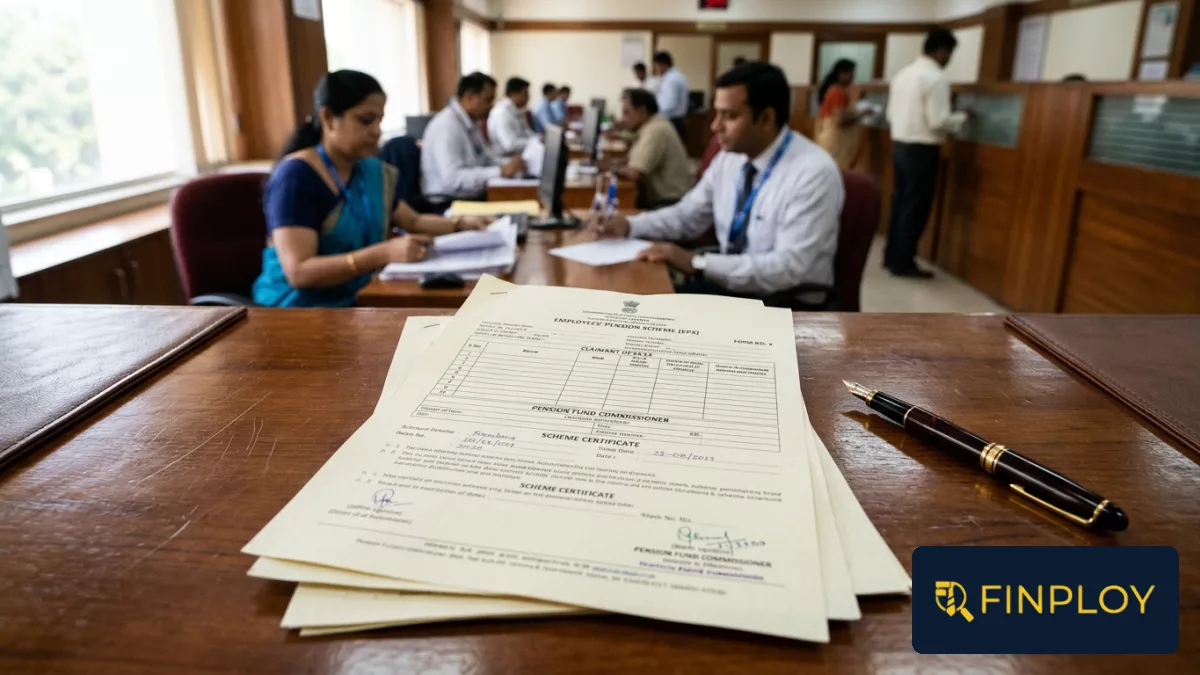
Executing an EPF withdrawal requires understanding the specific administrative forms prescribed by the authorities for different claim types. According to Tax Garden, Form 19 is designated for final EPF settlement upon complete exit or retirement, Form 31 is utilized for partial or advance EPF withdrawals during active service, and Form 10C is required for claiming Employee Pension Scheme (EPS) payouts.
The rules governing the pension component under the Employee Pension Scheme differ significantly based on an employee's total completed years of service. According to Stashfin, salaried employees who have completed less than 10 years of total service can claim a lump-sum EPS pension payout directly by submitting Form 10C. However, employees who have completed 10 or more years of service are barred from taking lump-sum cash withdrawals from their pension accumulated balance. Instead, these employees are issued a Scheme Certificate, which secures their entitlement to receive a monthly pension payout starting at age 58.
The turnaround time for processing these applications has been drastically reduced due to modern technological integration. According to CredFuse, under the EPFO 3.0 digital framework, claims submitted with an Aadhaar-seeded Universal Account Number (UAN) and verified electronic Know Your Customer (e-KYC) details can be authenticated seamlessly using Aadhaar One-Time Password (OTP) verification. This fully digital pipeline bypasses traditional manual employer verification procedures, allowing valid claims to be settled directly into the member's linked bank account within 3 working days.
4. Taxation Rules and TDS Implications under Section 10(12) and 192A
Understanding the tax implications of EPF withdrawals is crucial for avoiding unexpected tax liabilities during financial planning. According to Kotak Life Insurance, EPF withdrawals made after an employee completes 5 years of continuous service are entirely exempt from income tax under Section 10(12) of the Income Tax Act. For employees who have worked across multiple companies, service across different employers is counted as continuous, provided the accumulative PF balance from previous roles was officially transferred to the new employer's account rather than prematurely withdrawn.
Conversely, early withdrawals made prior to completing 5 years of continuous service attract tax liabilities and mandatory tax deduction at source. According to Indian HRM, if continuous service is under 5 years and the total withdrawal amount exceeds ₹50,000, Tax Deducted at Source (TDS) under Section 192A becomes applicable. For account holders who have linked their Permanent Account Number (PAN) with their UAN, TDS is deducted at a rate of 10%. However, for accounts where PAN is not linked, TDS is levied at a higher rate of 20%.
Specific tax relief mechanisms exist for low-income individuals or those with no net taxable income. According to Tax Garden, members whose total taxable income for the financial year falls below the basic exemption threshold can submit Form 15G (for individuals below 60 years) or Form 15H (for senior citizens), or Form 121 under updated procedural rules, to prevent the deduction of TDS on early EPF withdrawals.
5. EPF Withdrawal Reference Overview
To assist salaried professionals in understanding the exact forms, limits, and conditions for various EPF and EPS actions, the following structured reference table outlines key operational rules across withdrawal scenarios.
| Claim Category | Applicable Form | Service / Duration Condition | Key Limit & Rule |
|---|---|---|---|
| Final PF Settlement | Form 19 | Full exit / retirement | Requires 2 months of unemployment or retirement; tax-exempt after 5 years service. |
| Partial / Advance Claim | Form 31 | Active service | Auto-settlement up to ₹5 lakh; merged into 3 heads (Essential, Housing, Special). |
| EPS Pension (Under 10 Years) | Form 10C | Less than 10 years service | Allows lump-sum cash withdrawal of accumulated EPS pension balance. |
| EPS Pension (10+ Years) | Form 10C (Scheme Certificate) | 10 or more years service | No cash withdrawal permitted; Scheme Certificate issued for monthly pension at age 58. |
| Job Loss Withdrawal | Form 31 / Form 19 | 1 month unemployed (75%) / 12 months (25%) | Under EPF Scheme 2026, 75% accessible after 1 month; remaining 25% requires 12 months. |
6. Implications for Banking, NBFC, and Insurance Careers and Finploy Hiring Trends
The continuous digital transformation and expanding liquidity limits within the EPFO ecosystem directly influence workforce demand across India’s Banking, Financial Services, and Insurance (BFSI) sector. As EPFO rules evolve and auto-settlement processing accelerates, financial institutions require specialized skill sets to manage core integration, wealth advisory, and compliance operations.
According to HDFC Bank, the expansion of auto-settlement caps to ₹5 lakh requires deep core banking integration with EPFO backend engines. Institutional partnerships between the EPFO and major banking entities—such as India Post Payments Bank (IPPB), HDFC Bank, and leading public sector banks—have created strong hiring demand for BFSI technology professionals. Financial institutions are actively recruiting experts skilled in Application Programming Interface (API) management, automated clearing settlement systems like NEFT and RTGS, and automated digital KYC verification pipelines to process high-volume digital transactions seamlessly.
Simultaneously, the capital liquidity generated by higher advance limits has impacted consumer banking and wealth management roles. According to Bajaj Finserv, with auto-settlement limits raised to ₹5 lakh enabling rapid employee liquidity, financial planners, relationship managers, and insurance advisors across banks and NBFCs require updated product training. Professionals must be equipped to guide salaried clients on strategically reinvesting withdrawn EPF capital into structured wealth instruments, such as high-yield fixed deposits, mutual funds, or comprehensive life insurance coverage, ensuring that short-term liquidity does not compromise overall financial security.
From an organizational and operations perspective, human resource management in financial firms faces strict procedural requirements. According to CredFuse, HR operations and payroll teams within BFSI employers need specialized expertise in executing automated UAN transfers and accurately marking employee exit dates on the EPFO portal. Precise portal maintenance is critical to preventing claim rejections and transfer delays, particularly in high-turnover banking functions such as retail sales, field collection, and branch operations.
Data from Finploy reflects robust hiring activity across these core financial domain functions. As of today, 24 October 2026, Finploy lists a total of 43,262 open jobs in the BFSI sector across India. A major share of these opportunities is concentrated in key financial and technology hubs. Mumbai leads the country with 11,232 open BFSI positions on Finploy, reflecting its position as the primary hub for corporate banking, central treasury, and institutional operations. Bengaluru follows with 1,163 open roles, alongside Bangalore listing 570 roles, highlighting strong demand for fintech development, API engineering, and digital banking integration. Other prominent centers with significant BFSI job listings on Finploy include Pune with 1,116 open jobs, Chennai with 1,031 open jobs, Hyderabad with 834 open jobs, Thane with 528 open jobs, and Kolkata with 456 open jobs.
For professionals seeking mid-to-senior roles in banking operations, payroll management, and wealth advisory, mastering the regulatory mechanics of EPF and EPS systems alongside digital core integration represents a vital competency in India's evolving financial ecosystem.
Open jobs at these employers on Finploy

Archana Jain
Archana Jain is the Founder and CEO of Finploy Technologies, a recruitment platform built exclusively for banking, financial services and insurance (BFSI) hiring in India and Singapore. She has led Finploy since 2020 and has been Chief Operating Officer of Deeesha Finance & Finploy Finance Employment since 2016. Her work focuses on bank and NBFC hiring: leadership roles, home loan and LAP sales, CASA and retail banking, credit and underwriting, collections and recovery, and relationship management, across 1,500+ locations in India. She reviews Finploy Insights articles before they are published.